
Yohimbine in a Pre-Workout: What 2.5mg Actually Does
The smallest number on a 31.73g panel and the one we flag hardest. What alpha-2 antagonism is, why we stopped at 2.5mg, and the 2016 analysis that found most yohimbine labels inaccurate.
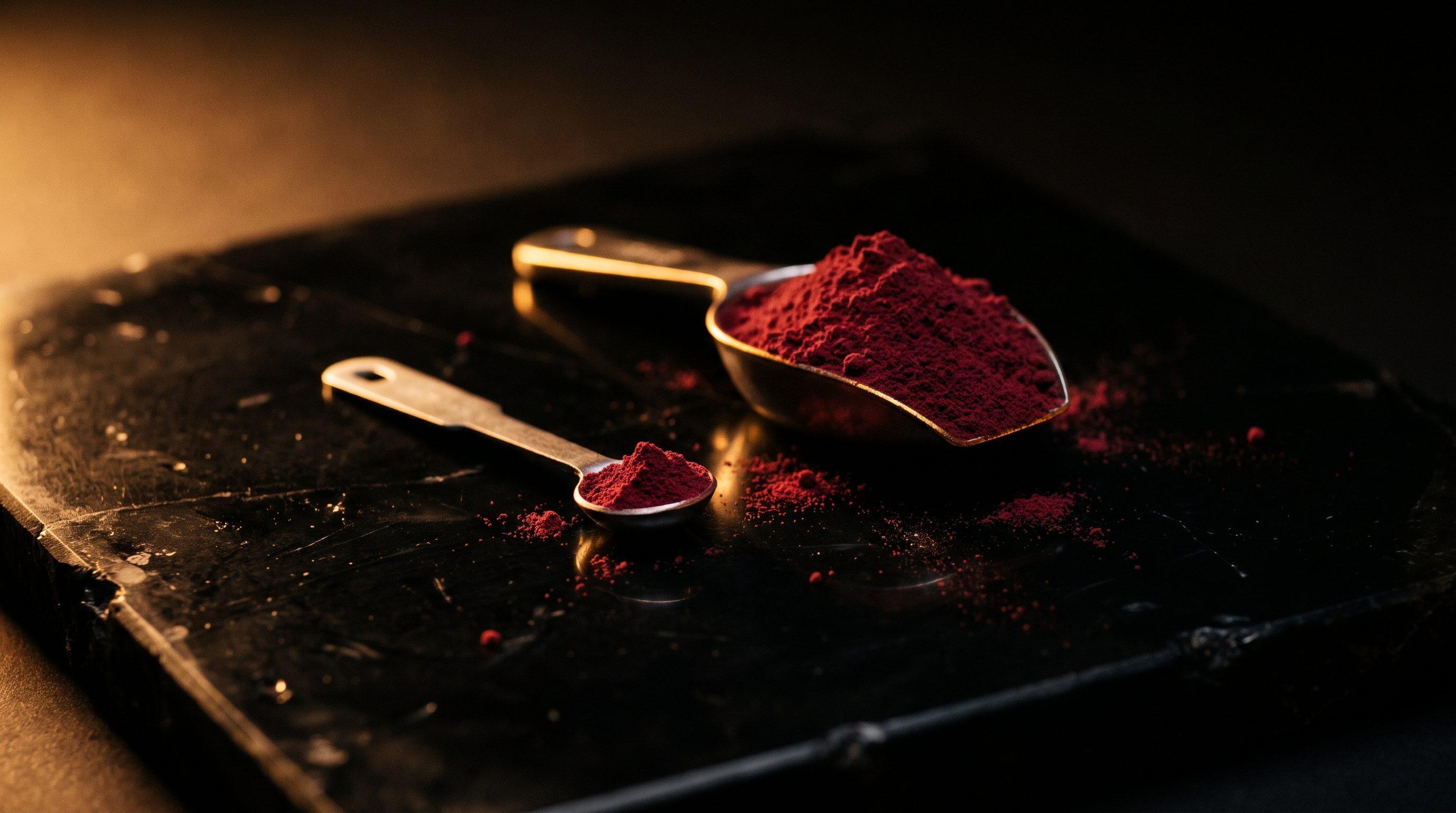
Yohimbine is an alpha-2 adrenergic receptor antagonist, and on our panel it is 2.5 mg. That is the honest whole of what yohimbine is doing in a pre-workout: it occupies a receptor that normally works as a brake on noradrenaline release, and it is the smallest listed dose in a 31.73 g scoop. Researchers are confident enough about that binding to use yohimbine as the tracer when they map those receptors in living people. A 2023 study in Biomolecules (Laurencin et al., volume 13, issue 5, article 843) put carbon-11 labelled yohimbine through PET scans on 46 healthy volunteers for that exact purpose, because where the yohimbine lands is where the alpha-2 receptors are.
What we will not do is turn a receptor occupancy into a promise about your training or your body. The mechanism is the mechanism. Everything past it is a claim, and 2.5 mg is not a dose we are willing to make claims at.
The Smallest Number on the Panel, and the One We Flag Hardest
Read our full ingredients panel top to bottom and the shape of it is obvious. The pump and buffer ingredients are printed in grams: 7 g L-citrulline malate, 7 g L-arginine, 4 g betaine anhydrous, 4 g beta-alanine. The neural side is printed in hundreds of milligrams: 400 mg caffeine anhydrous, 400 mg theobromine, 800 mg L-theanine, 1 g L-tyrosine. Then at the bottom sits yohimbine HCl at 2.5 mg, which is two and a half thousandths of a gram.
It is also the only line on that page we attach a warning to rather than a benefit. The panel calls it the sharpest tool there, a stimulant kept at a deliberate and conservative dose, and then tells you to respect it. Every other ingredient gets a sentence about what it is for. This one gets a sentence about restraint.
That is deliberate, and here is the opinion we will defend: the ingredients that start arguments are almost always the ones at the bottom of the panel, and the reason is that the bottom of the panel is where a formulator can move a number without anyone noticing. Nobody secretly halves 7 g of citrulline. Milligram ingredients are a different matter.
Why We Stopped at 2.5 mg
We could have put more in. Plenty of formulas do, and a bigger yohimbine number reads as a bolder product on a shelf.
We did not, for a reason that has nothing to do with what yohimbine might or might not accomplish. There is no quantity of yohimbine we could print and then honestly describe as gentle, so the choice was between a conservative dose we would stand behind in writing and a larger one we would have to hedge about. Gladiatore already carries 400 mg of caffeine. Adding a second ingredient we would need to apologise for was never on the table.
If you want the walk through all twelve ingredients and what each one is doing next to the others, that is the full panel, explained.
The Number on the Label Is the Part Nobody Checks
Here is the research that should actually change how you shop, and it is not about what yohimbine does in your body. It is about whether the yohimbine figure on a tub is real.
A 2016 analysis in Drug Testing and Analysis (Cohen et al., volume 8, issues 3 to 4, pages 357 to 369) bought 49 brands of supplements labelled as containing yohimbe or yohimbine from seven major US retailers and measured what was actually in them by mass spectrometry. Per recommended serving, the yohimbine those authors found ranged from none detected to 12.1 mg. Only 11 of the 49 brands printed a specific yohimbine quantity on the label at all, that paper reports, and most of the ones that did were inaccurate, with measured content running from 23 percent to 147 percent of the label claim. Nine of the 49 said nothing anywhere on the label about yohimbine's adverse effects, the same authors found. By that paper's count, two brands out of the 49 gave a buyer both an accurate quantity and that safety information.
Two out of 49. Sit with that number for a second, because it reframes the question you came here with. Asking what yohimbine does in a pre-workout assumes the amount on the panel is the amount in the tub, and in that sample it usually was not.
This is the whole argument for printing full panels with no blends behind them. A dose you cannot verify is not a dose, it is a marketing figure, and an ingredient with a short leash is exactly the wrong place to be guessing.
The Exclusions Exist for This Line Too
People read the cautions on our dosing and timing page as the caffeine talking. The caffeine is most of it. It is not all of it.
The label directs one scoop of 31.7 g mixed with 8 to 12 oz of cold water, 20 to 30 minutes before training, and it directs a half scoop first to assess tolerance. It caps you at one serving in any 24 hour period. Those are printed directions, not suggestions we added later, and they are written for the full stack rather than for any single line on it.
- Half a scoop on your first sessions, and judge how it sits before you ever measure a full one.
- One serving inside 24 hours, with no second pre-workout and no coffee or energy drink stacked on top.
- Not for anyone under 18, pregnant or nursing, or new to stimulants.
- If you have a heart condition or a blood-pressure issue, or you take medication, the conversation is with your physician before the first scoop, not with a label.
That last line is the one we would underline. It is standing advice for a 400 mg caffeine formula on its own, and the 2.5 mg at the bottom of the panel is a second reason it is there.
Is 2.5 mg of yohimbine a lot?
It is a deliberately conservative dose, and it is the smallest listed amount on a 31.73 g scoop. For scale, the 2016 Drug Testing and Analysis survey of 49 labelled products found per-serving yohimbine content ranging from none detected up to 12.1 mg. We are not going to tell you a milligram figure is safe for you specifically, because that depends on you and on what else you are taking, which is why the label's exclusions and the physician line are written the way they are.
What is the difference between yohimbe and yohimbine?
Yohimbe is the tree. Yohimbine is one alkaloid from it. The 2016 Drug Testing and Analysis paper describes extracts of the evergreen Pausinystalia johimbe, sold in hundreds of US supplements, and identifies yohimbine as the most active of the alkaloids those extracts contain. A label reading yohimbe bark extract is telling you about a plant extract. A label reading yohimbine HCl 2.5 mg is telling you a quantity of a specific compound. Those are not the same statement, and only one of them is checkable.
Can I take Gladiatore with coffee?
No. The label caps the formula at one serving in 24 hours and directs you not to stack other caffeine sources with it, and a full scoop is already 400 mg of caffeine anhydrous before anything you add. The morning coffee counts.
These statements have not been evaluated by the Food and Drug Administration. This product is not intended to diagnose, treat, cure, or prevent any disease.