
Electrolytes Before Bed: What They Do and When People Take Them
Electrolytes are charged minerals, and sodium is the one that matters most. What the research actually measured, what is printed on our own panel, and why the real evening question is the caffeine.
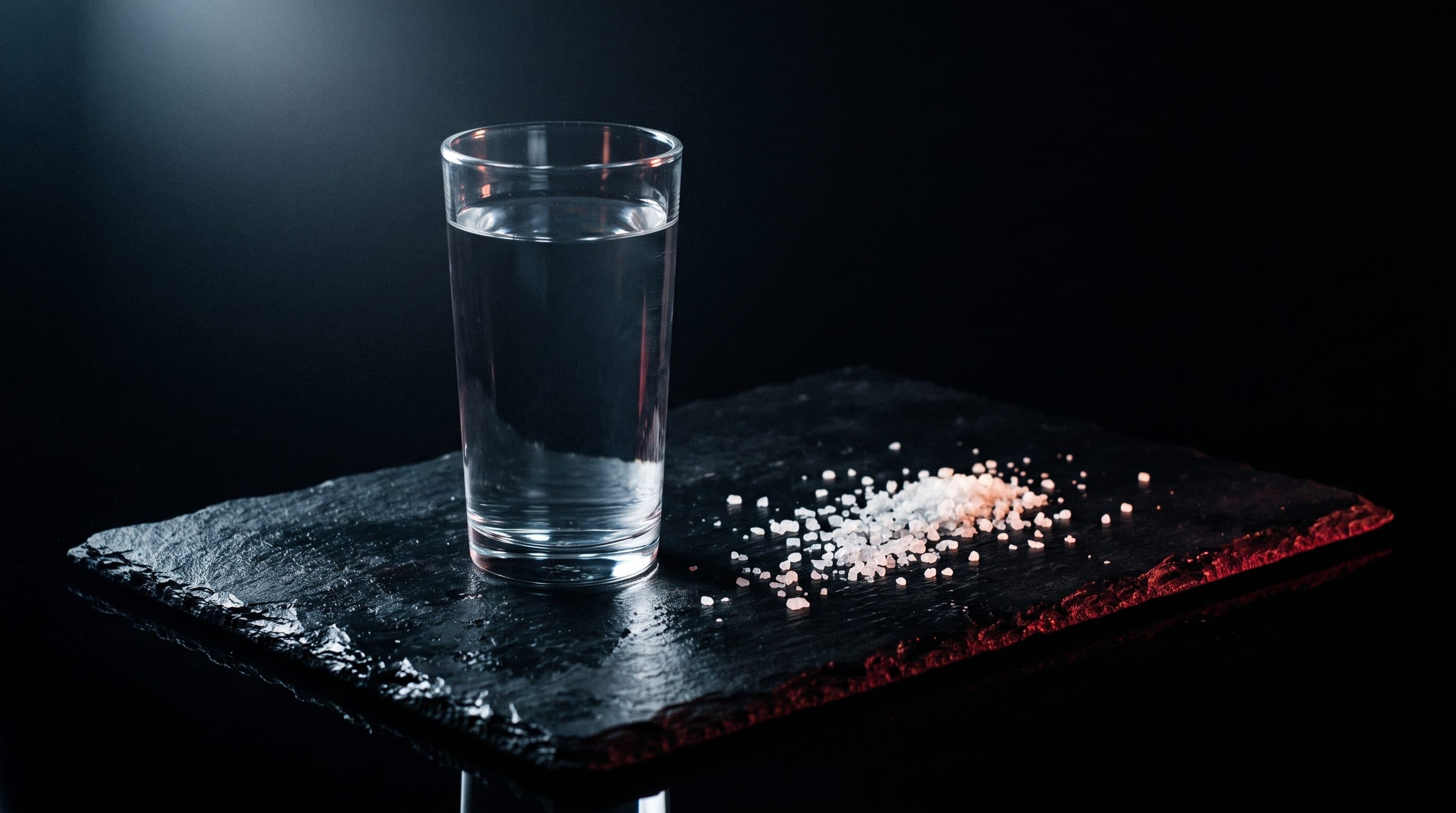
Electrolytes are minerals that carry an electrical charge in solution, and the ones people mean when they say the word are sodium, potassium, magnesium, calcium and chloride. Taking them in the evening is a timing question, not a magic one, and the honest answer is that what matters is how much you lost that day and what else you put in the glass. We are going to stay on what the labels say and what the published research measured, because that is the only ground where this question has a real answer.
We get asked this more in summer and more by people who train at night. It usually arrives attached to a second question, which is whether an evening scoop of anything with caffeine in it is a problem. Those two things need separating, so we will do that first.
What an electrolyte actually is
A mineral that dissociates into charged particles in water. That is the whole definition.
Sodium is the one present in the largest amount in sweat, and it is the one most of these products are built around. Potassium, magnesium and calcium appear in smaller amounts. Chloride rides along with sodium. A product selling itself on electrolytes is mostly selling you sodium with a supporting cast, and reading the panel tells you which.
The American College of Sports Medicine's position stand on exercise and fluid replacement, Sawka et al., 2007, is the reference most of this traces back to. It documents that sweat sodium losses vary widely between individuals and with how acclimatised someone is, which is why a single number for what anybody needs does not exist and why any product quoting one is guessing on your behalf.
What is on our panel, exactly
Gladiatore is a pre-workout, not an electrolyte product, and we would rather say that plainly than let the categories blur.
That said, two of the 12 ingredients on the full scoop panel are minerals people would recognise from an electrolyte label. The full scoop is 31.73g and it contains 800mg sodium bicarbonate and 45mg magnesium citrate. Sodium bicarbonate is on there for the reason the ISSN position stand on sodium bicarbonate, Grgic et al., 2021 describes, which is a buffering mechanism studied in short high-intensity work, and the research doses in that literature are considerably larger than 800mg. We print the number rather than imply the dose does something it was not studied at.
The rest of the panel is 400mg caffeine anhydrous, 400mg theobromine, 800mg L-theanine, 7g L-citrulline malate in a 2:1 ratio, 7g L-arginine, 4g betaine anhydrous, 4g beta-alanine, 1g L-tyrosine, 2.5mg yohimbine and 1g vitamin C. Every one of those is printed with its dose, which is the only way a reader can check any of this. We wrote up why at why we do not use proprietary blends, and the full ingredient breakdown is on the ingredients page.
The caffeine question is the real one
If you trained at night and you are thinking about what to take afterwards, caffeine is the variable that actually matters, and it has nothing to do with electrolytes.
Caffeine's half-life in healthy adults is commonly cited at around 5 hours, meaning roughly half of a dose is still circulating 5 hours later. The ISSN position stand on caffeine and exercise performance, Guest et al., 2021 sets out the pharmacokinetics and the wide individual variation in how fast people clear it, which is driven partly by genetics and partly by habitual intake.
Run that arithmetic against a full scoop of Gladiatore at 400mg and you can see why we say what we say about timing. A full scoop taken at 8pm leaves a substantial amount of caffeine on board at 1am for most people, and more than that for a slow metaboliser. That is a timing fact, not a warning about a health outcome, and it is the reason our guidance has always been one serving per 24 hours, not to stack it with other caffeine sources, and to start with a half scoop until you know how you respond. That guidance lives on how to use.
An electrolyte product with no stimulant in it does not raise this question at all. Which is the point: the question people are really asking is usually about the caffeine, and they have attached it to the wrong ingredient.
How to read any electrolyte label
Four things, in this order.
- Sodium in milligrams per serving. This is the number that separates products, and it ranges enormously. Read it per serving, then check how many servings are in the container.
- What the serving actually is. A scoop, a stick, half a stick. Products are not comparable until you have normalised to one serving.
- Whether the other minerals are at amounts worth printing. Potassium and magnesium at single-digit milligrams are present for the ingredient list rather than for any measured effect.
- What else is in it. Sugar, caffeine, colours, sweeteners. A product can be an electrolyte mix and a stimulant at the same time, and the front of the package rarely leads with the second part.
Our own pre-workout label checklist runs the same method on a different category, and it is the same discipline either way: every active, with its dose, in a unit you can compare.
What we are not going to tell you
We are not going to tell you that taking minerals before bed does anything to how you sleep. We have not run that study, the label does not claim it, and the research we would have to lean on to say it is not research about this product.
What we will say is the boring, checkable version. Sweat losses vary by person and by conditions. Sodium is the mineral lost in the largest quantity. Labels state their doses and most of the arguments disappear once you read them. If you trained late and took a full scoop of a 400mg caffeine pre-workout, the thing worth thinking about at bedtime is the caffeine, not the magnesium.
Gladiatore is not for anyone under 18, anyone pregnant or nursing, anyone sensitive to stimulants, anyone with a heart condition, or anyone taking medication. One serving per 24 hours. Start with a half scoop. More of the common questions are on the FAQ.
These statements have not been evaluated by the Food and Drug Administration. This product is not intended to diagnose, treat, cure, or prevent any disease.
What are electrolytes, exactly?
Minerals that dissociate into charged particles in water. The ones meant by the term are sodium, potassium, magnesium, calcium and chloride. Sodium is present in the largest amount in sweat and is what most electrolyte products are built around, with the others in smaller supporting amounts.
Does Gladiatore contain electrolytes?
Gladiatore is a pre-workout, not an electrolyte product. Two of the 12 ingredients on the full scoop panel are minerals people would recognise from an electrolyte label: 800mg sodium bicarbonate and 45mg magnesium citrate. The research doses in the sodium bicarbonate literature are considerably larger than 800mg, which is why the number is printed rather than framed as a dose that does something it was not studied at.
How long does caffeine stay in your system after an evening workout?
Caffeine's half-life in healthy adults is commonly cited at around 5 hours, so roughly half of a dose is still circulating 5 hours later, and clearance varies widely between individuals. Against a full scoop of Gladiatore at 400mg caffeine anhydrous, a serving taken at 8pm leaves a substantial amount on board at 1am for most people. That is the reason for one serving per 24 hours, not stacking other caffeine sources, and starting with a half scoop.
How do you read an electrolyte label properly?
Check sodium in milligrams per serving first, since that is what separates products, then confirm what the serving actually is so two labels are comparable. Look at whether the other minerals appear at amounts worth printing rather than single-digit milligrams added for the ingredient list. Then read what else is in it, because a product can be an electrolyte mix and a stimulant at the same time and the front of the package rarely leads with the second part.