
Why Pre-Workout Clumps, and How to Store It So It Doesn't
Why does pre-workout clump? Four of Gladiatore's ingredients pull moisture straight out of the air. Here is the physical chemistry behind clumping, why the silica packet does not belong on top, and a storage routine that keeps a tub loose to the last scoop.
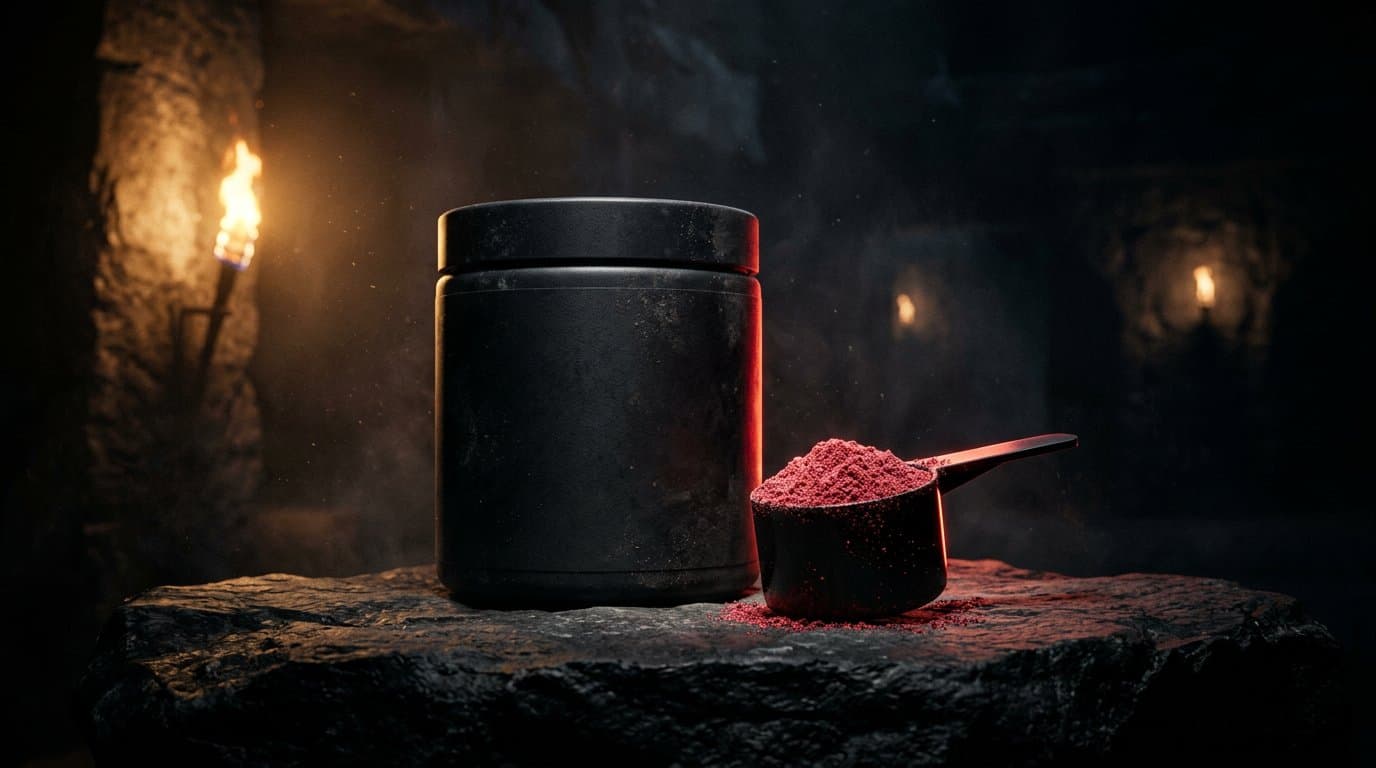
Why does pre workout clump? Four of the twelve ingredients printed on the Gladiatore™ label, L-citrulline malate, beta-alanine, betaine anhydrous, and sodium bicarbonate, are hygroscopic, meaning they pull moisture straight out of the surrounding air. A humid kitchen, an open lid, or one scoop dipped in with a damp spoon is often all it takes to turn a loose powder into a solid mass over a few weeks.
Updated August 2026. This is a storage guide, not a product pitch. We are a family-owned supplement brand out of Freehold, New Jersey, and the one rule the whole company runs on is that every dose gets printed so anyone can check it. We are using our own printed Gladiatore™ panel as the worked example here because every ingredient on it is visible, so we can point at the exact actives that behave this way instead of speaking generically about "supplement powder." This article covers physical chemistry and storage only. It is not medical advice, and it does not make any claim about whether a clumped tub is safe or effective to use. That is a separate question, and one this article does not answer.
Hygroscopic ingredients pull water out of the air
A hygroscopic ingredient is one that absorbs water vapor directly from the surrounding air, without needing liquid to touch it at all. Sugar, table salt, and baking soda all behave this way, which is why a salt shaker seizes up on a humid day even if nobody ever spills a drop on it. Several actives on the Gladiatore panel share that property.
Four ingredients on the label are the ones doing most of the work: L-citrulline malate (7g per full scoop), beta-alanine (4g), betaine anhydrous (4g), and sodium bicarbonate (800mg). Each of these is a fine, water-attracting crystalline powder on its own, and a tub carrying all four at multi-gram doses has a lot of surface area exposed to whatever air gets into the container. This is a property of the raw ingredients themselves, not a defect specific to any one brand's manufacturing. Any formula that doses these actives at real, studied amounts (rather than a token pinch) is working with the same hygroscopic chemistry.
Worth being precise about what this is not. Some pre-workout formulas rely on a reaction between an acid, like citric acid or ascorbic acid (vitamin C), and a carbonate, like magnesium carbonate, to fizz or dissolve differently. That is a separate chemical mechanism, and it is not what is happening here. Gladiatore's magnesium comes from magnesium citrate, not magnesium carbonate, so that acid-carbonate reaction does not apply to this formula. What is happening on this panel is simpler: several ingredients are individually good at grabbing ambient moisture, and clumping is what that looks like at the bottom of a tub.
What the humidity in your kitchen does to an open tub
Relative humidity is not the same everywhere in a house, and it is rarely the same everywhere in the country. A tub stored in a coastal or humid-climate kitchen is sitting in air that already carries more water vapor than one stored in a dry inland climate, and the powder inside responds to whichever air it is actually exposed to, not to the climate outside the house as a whole.
Two moments matter more than the ambient humidity of the room. The first is every time the lid comes off. Powder near the surface is exposed to whatever air is in the kitchen at that instant, and if that air is warm and damp, water vapor migrates into the top layer of the tub during the seconds the lid is open. The second is what happens right after: a lid that is not fully reseated lets that humid air keep exchanging with the tub's interior long after you have walked away with your shaker. A loose lid left ajar overnight does more damage than a hundred quick scoops with the lid snapped shut each time.
This is also why a tub kept in a bathroom or on a windowsill clumps faster than the identical tub kept in a pantry. Bathrooms run through humidity spikes every time someone showers, and a windowsill exposes the container to daily temperature swings on top of whatever humidity is already in the room. Neither location is doing the powder any favors.
The silica packet is not trash, and it is not meant to sit on top
Every Gladiatore tub ships with a small silica gel desiccant packet, and it has one job: absorb the ambient moisture inside the sealed container before that moisture reaches the powder. Silica gel is chemically inert and works by physically trapping water molecules inside its porous structure, not by reacting with anything in the formula.
Two common habits defeat it. The first is throwing the packet away the moment the tub is opened, on the assumption that it is packaging waste rather than a functional part of the product. The second, more common mistake is leaving the packet loose on top of the powder instead of pushing it down so it sits buried inside the tub. A desiccant works on the air immediately around it. Sitting on the surface, it can only protect the very top layer it happens to touch. Pushed down into the powder, it is positioned to intercept moisture as it works its way in from the lid, which is the direction humidity actually travels once the tub is sealed back up.
If the original packet is ever lost, a fresh food-safe silica packet (the kind that ships with shoes, electronics, or other supplement tubs) does the same job. The point is having something in the container actively pulling ambient moisture away from the powder, not the specific packet that shipped with it.
Scooping with a wet scoop: the single most common cause
Of everything covered here, this is the habit most likely to be the actual cause of a clumped tub. Rinsing a scoop under the tap after a workout, setting it on the counter to air-dry, and then dipping that same scoop straight into the tub the next morning introduces liquid water, not just humid air, directly into the bulk powder.
Liquid water does far more damage than ambient humidity ever will, because it does not just sit on the surface, it wicks into whatever powder it touches and dissolves the hygroscopic actives on contact. Where humid air might soften the top quarter-inch of a tub over weeks, one genuinely wet scoop can start a hard clump in a single dip, and that clump then continues absorbing more moisture from the air around it because the surface area of a solid clump is different from loose powder.
The fix is mechanical, not a change to the formula: keep the scoop bone-dry before it goes anywhere near the tub. A scoop drying on a rack next to the sink is a scoop that is not yet dry enough to use. Give it a full dry cycle, or keep a second dedicated dry scoop in rotation, so the wet one is never the one that goes into the powder.
Heat, cars, gym bags, and sunlight
Temperature swings compound the moisture problem in a way that is easy to miss because the cause is not obvious at the time. A tub that spends the morning in a cold car and the afternoon in a warm, humid gym bag goes through the same physics as a cold glass of water on a summer day: as the tub warms up, any air trapped inside it can hold more moisture, and if that air was already carrying humidity, it deposits some of that moisture onto the cooler powder as everything equalizes to room temperature. This is condensation, the same mechanism that fogs a car windshield, just happening on a smaller scale inside a sealed container.
Direct heat on its own also plays a role, separate from humidity. A tub left in direct sunlight, on a car dashboard, or near a heat vent gets warm enough that the powder can soften and compact under its own weight, especially near the bottom where the stack of powder above is pressing down. That kind of clumping is closer to how brown sugar hardens in a hot pantry than to the humidity-driven clumping described above, but the result at the bottom of the tub looks similar either way.
The practical takeaway is the same for both: a tub that travels should travel in a bag or car for as short a time as possible, and it should come back to room temperature with the lid still on before that lid gets opened. Opening a cold tub straight into a warm, humid gym is stacking the two worst conditions on top of each other at once.
How to store a tub so it stays loose to the last scoop
None of this requires anything beyond the habits below. Read each row as a pair: the thing that keeps a tub loose, and the specific habit that undoes it.
| Do this | Not this |
|---|---|
| Snap the lid fully shut immediately after every scoop | Leave the tub open on the counter while you mix your shaker |
| Store the tub in a cool, dry cabinet or pantry | Store it on a bathroom shelf, windowsill, or near a stove |
| Keep the silica packet pushed down into the powder | Throw the packet away or leave it loose on top |
| Use a fully dry scoop every single time | Rinse the scoop and dip it back in before it is bone-dry |
| Let a tub that traveled in a cold car or bag reach room temperature before opening the lid | Open a cold tub straight into a warm, humid gym or kitchen |
None of these five habits take more than a few extra seconds, and together they address every mechanism covered above: ambient humidity, condensation from temperature swings, and direct liquid contact from a wet scoop.
What clumping does and does not tell you about a product
Clumping is a physical, environmental response, moisture meeting hygroscopic ingredients, and nothing more. It is not a signal about how the powder was manufactured, and reading it that way is a mistake in either direction: a perfectly loose tub is not proof that a formula is well-made, and a clumped one is not proof that it is poorly made. Both outcomes depend heavily on the humidity, temperature, and handling the tub was actually exposed to after it left the factory, which varies by household far more than it varies by brand. Evidence of what is actually in a tub comes from a batch-specific certificate of analysis, not from how the powder looks, and we walked through what that document covers in what third-party tested really means on a label.
What this article is not addressing, and deliberately so, is whether a clumped tub is still fine to use once it happens. That is a separate question about the product itself, not about the physical chemistry of why clumping occurs, and it is outside the scope of a storage guide. If you have questions about a specific tub, the fastest path is contacting us directly rather than guessing from how the powder looks.
Why does pre-workout clump: quick FAQ
Why does my pre-workout turn into a solid brick?
The most common cause is a wet scoop making direct contact with the powder, since liquid water dissolves hygroscopic ingredients on contact rather than just sitting on the surface the way ambient humidity does. A loose or frequently opened lid in a humid room is the second most common cause. Both are storage and handling issues, not something wrong with the formula itself.
Is it normal for pre-workout to clump a little?
Some fine clumping near the top of an opened tub is expected with a formula that carries hygroscopic actives like citrulline malate, beta-alanine, betaine, and sodium bicarbonate at real, studied doses. A few soft clumps that break apart easily with a scoop are typical. A tub that has hardened into one solid block usually points to a specific cause, most often a wet scoop, a loose lid, or storage somewhere warm and humid.
Should I throw away the silica packet that comes in the tub?
No. The silica packet is a desiccant meant to absorb ambient moisture inside the sealed tub, and it works best pushed down into the powder rather than discarded or left loose on top. If the original packet is ever lost, any fresh food-safe silica packet does the same job.
Does storing pre-workout in the fridge help it stay loose?
Not usually, and it can make things worse. Moving a tub between a cold fridge and a warm kitchen repeatedly creates the same condensation problem as a tub that travels in a cold car: as the tub warms back up, moisture in any trapped air can settle onto the cooler powder. A cool, dry room-temperature cabinet or pantry is a more stable environment than a fridge that gets opened several times a day.
Why does pre-workout only clump near the top of the tub?
Because the top layer is what is directly exposed to the air every time the lid comes off, it is usually the first part of the tub to absorb ambient humidity. Powder deeper in the tub is more protected until the lid has been open enough times, or left ajar long enough, for that humid air to work its way further down.
Does clumping mean the ingredients have gone bad?
Clumping on its own is a physical response to moisture, not a sign of ingredient breakdown. This article covers only the storage and humidity side of the question; it does not address whether a given tub is still fine to use once it has clumped. If you have questions about a specific tub, contact us directly rather than guessing.
Why does pre-workout clump comes down to a handful of hygroscopic ingredients meeting moisture they were never going to avoid meeting eventually, either from the air, a wet scoop, or a temperature swing. The five habits above (a fully sealed lid, cool dry storage, a buried silica packet, a bone-dry scoop, and letting a traveled tub reach room temperature before opening) address every mechanism covered here and take only a few seconds each.
If you want to see the full printed panel that includes the four hygroscopic actives named above, the active-by-active breakdown at full-scoop doses is on the Gladiatore ingredients page, and the complete twelve-ingredient list is walked through in what's in Gladiatore. Gladiatore itself is a high-stimulant pre-workout made for lifters and combat athletes with real stimulant experience, and it ships nationwide from the Gladiatore product page.
A reminder on the product itself, since this is a storage guide and not a dosing one: it is a high-stimulant pre-workout meant for lifters and combat athletes who already run stimulants. Mix a single scoop into 8 to 12 oz of cold water roughly 20 to 30 minutes ahead of a session. Start with a half scoop to assess tolerance. Do not exceed one serving in 24 hours. Do not stack with other caffeine. Skip it entirely if stimulants hit you hard, if this would be your first pre-workout, if you are under 18, pregnant or nursing, living with a heart condition, or taking any medication. When in doubt, ask a physician first.
These statements have not been evaluated by the Food and Drug Administration. This product is not intended to diagnose, treat, cure, or prevent any disease.