
Coffee vs. Pre-Workout: What Your Cup Actually Does Before a Lift
Coffee is the most popular pre-workout on earth, and for good reason: it is roughly 95mg of caffeine that works. But caffeine is the only performance ingredient in the cup. Here is the ingredient-by-ingredient comparison, what the research says coffee cannot do, and how Gladiatore's twelve-active label stacks up.
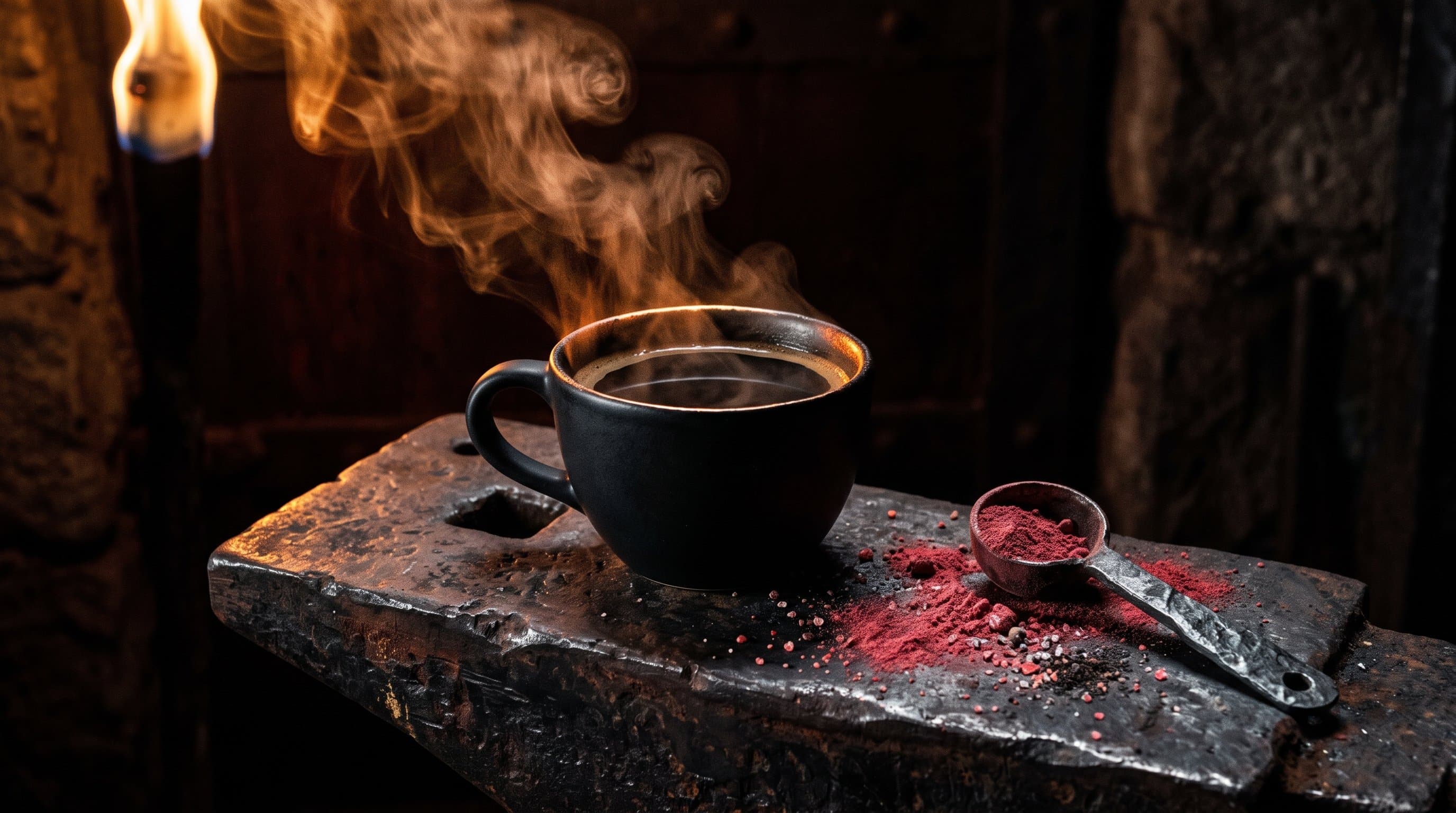
The coffee vs pre-workout question comes down to one number and one list. Coffee gives you caffeine and little else, roughly 95mg per cup. A full scoop of Gladiatore delivers 400mg of caffeine plus 14g of nitric-oxide precursors, 4g of beta-alanine, and 4g of betaine that coffee has none of. Coffee is one ingredient; a formulated pre-workout is twelve.
Updated July 2026. One of the most-watched training clips in this whole category has a trainer answering a pre-workout question with "my number one favorite pre-workout is coffee." As far as it goes, that is a fair point. Caffeine is the single most-validated ergogenic aid in sports nutrition, and coffee delivers it cheaply and reliably. The problem is not what that answer says. It is what it leaves out.
This is not a coffee takedown. Coffee is a real tool, and for a lot of training it is enough. But "coffee vs pre-workout" is not a caffeine-versus-caffeine question, because both deliver the exact same molecule. It is a one-ingredient-versus-twelve question. Here is the ingredient-by-ingredient breakdown, matched against the peer-reviewed research and our printed Gladiatore label.
Is coffee actually a good pre-workout?
Yes, coffee is a legitimate pre-workout, because caffeine is a legitimate ergogenic aid and coffee is a clean delivery system for it. The International Society of Sports Nutrition's position stand on caffeine associates doses in the range of roughly 3 to 6mg per kilogram of bodyweight with improvements in muscular endurance, strength, sprint output, and perceived exertion. Coffee lands you inside that window with no additives and no learning curve. If your training is general strength and conditioning and all you want is the caffeine, coffee genuinely works.
The honest limit is that caffeine is the only performance ingredient in the cup. Everything coffee does for your training, it does through one molecule. That is a feature if caffeine is all you need. It is a ceiling the moment you want anything caffeine cannot do, which is where a formulated pre-workout starts to separate from the mug.
How much caffeine is in coffee vs a pre-workout?
A standard 8oz cup of brewed coffee runs about 95mg of caffeine, per the FDA's consumer guidance, while a full scoop of Gladiatore delivers 400mg, roughly four cups in a single drink. The number is only half the difference. The other half is the delivery window: coffee spreads across a morning, a full scoop hits in one.
- One 8oz cup of brewed coffee: about 95mg
- Single espresso shot: roughly 63mg
- Gladiatore, half scoop: 200mg
- Gladiatore, full scoop: 400mg
There is a second, quieter difference in that comparison: consistency. The caffeine in a cup of coffee is a moving target. Bean type, roast, grind, brew method, and cup size push a single "cup" anywhere from 50mg to well over 200mg. A scoop of Gladiatore is a printed, fixed 400mg (or 200mg at a half scoop) every single time. When you are managing a stimulant load deliberately, a known dose is worth something a variable one is not. The FDA notes around 400mg of caffeine per day is not generally associated with negative effects in healthy adults, and it is a lot easier to stay inside that ceiling when you can read the exact number on the panel.
Does the caffeine in coffee work any differently than caffeine anhydrous?
No, the caffeine molecule is identical whether it comes from a coffee bean or from caffeine anhydrous, so gram for gram it acts the same on your adenosine receptors. What differs is not the caffeine, it is what rides alongside it. In coffee, the caffeine rides essentially alone. In Gladiatore, 400mg of caffeine is paired with 800mg of L-theanine at a deliberate 2:1 ratio.
That pairing is one of the most-studied combinations in the category. Research associates caffeine plus L-theanine with better accuracy and attention than caffeine alone, while smoothing the jittery, scattered edge that a big caffeine dose can bring on its own (Owen et al., 2008, Nutritional Neuroscience). Black coffee gives you the caffeine spike with none of that support. If high-caffeine drinks tend to leave you wired and then flat, the formula math behind that is worth understanding before you blame the dose. We break the mechanism down in why pre-workouts crash you and how to avoid it.
What ingredients does coffee lack that actually change a workout?
Coffee lacks every performance ingredient except caffeine: it has zero grams of the pump, buffering, endurance, and focus actives that a fully-dosed pre-workout is built around. That single fact is the whole comparison. Here is what a full scoop of Gladiatore puts next to the caffeine, and coffee simply does not have.
- Pump and blood flow: 7g L-citrulline malate 2:1 plus 7g L-arginine. Fourteen grams of nitric-oxide-precursor aminos that widen blood vessels and move more blood into working muscle. A frequently cited randomized crossover study associated 8g of citrulline malate before training with more reps to failure and less soreness two days later (Perez-Guisado and Jakeman, 2010, Journal of Strength and Conditioning Research). Coffee: 0g.
- Muscular endurance buffering: 4g beta-alanine plus 800mg sodium bicarbonate. Beta-alanine raises muscle carnosine, which buffers the acid that builds during hard efforts; the ISSN position stand clusters effective intake in the multi-gram-per-day range. It is also the source of the pre-workout tingle, explained in why pre-workout makes you tingle. Coffee: 0g.
- Power and cellular hydration: 4g betaine anhydrous. Trials associate betaine with small but measurable improvements in power output in trained lifters. Coffee: 0g.
- Focus under fatigue: 1g L-tyrosine plus 800mg L-theanine. Tyrosine is a precursor to the catecholamines your brain burns through under stress; theanine smooths the stimulant edge. Coffee: 0g of either.
- A longer energy tail: 400mg theobromine. A second methylxanthine with a longer half-life than caffeine, layered to extend the curve. Coffee contains only trace theobromine, nowhere near a functional dose.
- The foundation: 1g vitamin C, 45mg magnesium citrate, 2.5mg yohimbine. Antioxidant support, an electrolyte top-up, and one sharp adrenergic stimulant. Coffee: none of these.
That is the unique data point, and it is not a marketing line: measured on the actives that research associates with training performance beyond caffeine, coffee scores zero across the board. A cup of coffee is 95mg of caffeine in water. A full scoop of Gladiatore is 400mg of caffeine plus eleven other printed ingredients doing jobs caffeine cannot. For the full label read, every gram explained, see what is in Gladiatore: all 12 ingredients.
So is a full scoop just four coffees?
On caffeine alone, yes, 400mg is roughly four cups of coffee, but that is exactly why it is an experienced-user product and not a casual swap. Front-loading most of a healthy adult's entire daily caffeine allowance into one drink is the whole point of a high-stim pre-workout, and it is also the whole reason for the half-scoop start rule. Four cups of coffee spread across a morning and 400mg in one shaker are not the same experience, even though the caffeine total matches.
That is the number people most often get wrong in both directions, so we wrote a full breakdown of where 400mg sits, who it is right for, and who has no business near it: is 400mg of caffeine too much for a pre-workout. If you already drink four coffees before you train, you are running the caffeine load without any of the supporting formula. Gladiatore is the same caffeine ceiling with the other eleven ingredients attached.
When is coffee the better choice?
Coffee is the better choice any time caffeine is all you actually want, and a transparency-first brand should say that plainly rather than pretend the mug has no place. There are real situations where reaching for coffee is the smarter call:
- General daily energy. If you are not chasing a hard session, a cup of coffee is cheaper, simpler, and plenty.
- Low-stim or rest days. When you want a small, adjustable caffeine hit instead of a fixed 400mg, coffee lets you sip to the dose you want.
- Stimulant sensitivity. If a high-stim formula is not for you, 95mg of coffee is a far more forgiving starting point than a full scoop.
- Cost and convenience. Coffee is already in your kitchen. There is no reason to overcomplicate an easy session.
- GI tolerance. Some people handle warm coffee better than a concentrated cold scoop, and that is a legitimate reason to stick with the cup.
The point is not that pre-workout beats coffee at everything. It is that they are built for different jobs. Coffee is a caffeine delivery system. A pre-workout is a full training stack. If your session only asks for caffeine, coffee answers it.
How do you actually choose between coffee and pre-workout?
You choose by matching the tool to what the session demands, then respecting the caffeine math either way. Here is the sequence, in order:
- Step 1: Ask what the session needs. Just want to feel awake and get moving? Caffeine alone is fine, and coffee delivers caffeine.
- Step 2: Decide whether you want the supporting actives. If you want pump, buffering, and endurance ingredients working alongside the caffeine, coffee physically cannot supply them. That is a pre-workout job.
- Step 3: Count your total daily caffeine first. Whichever you pick, add it up against a roughly 400mg-per-day ceiling for healthy adults. A full scoop of Gladiatore is most of that in one serving.
- Step 4: If you go pre-workout, start with a half scoop. That is 200mg of caffeine and half of every other active. Assess tolerance before you ever run a full scoop. One serving per 24 hours, mixed in 8 to 12oz of cold water, 20 to 30 minutes before training. Never dry-scoop it.
- Step 5: Never stack them. Do not run coffee on top of a full-caffeine pre-workout in the same window. Count all caffeine sources as one total, not separate budgets.
Coffee vs pre-workout: quick FAQ
Is coffee vs pre-workout really just a caffeine question?
No. Both coffee and pre-workout deliver caffeine, so on caffeine alone they are interchangeable at matched doses. The real difference is everything else: a formulated pre-workout like Gladiatore adds pump ingredients, buffers, endurance actives, and focus support that coffee does not contain. It is a one-ingredient tool versus a twelve-ingredient one.
Does pre-workout have more caffeine than coffee?
Usually, yes. A cup of brewed coffee is about 95mg of caffeine. A full scoop of Gladiatore is 400mg, roughly four cups in one drink, with a 200mg half-scoop option. Because that is a high single dose, the label directs you to start with a half scoop, take only one serving per 24 hours, and avoid stacking any other caffeine source on top.
Can I just add supplements to coffee instead?
You can stir individual ingredients into coffee, but you are then responsible for sourcing, dosing, and measuring each one at the amounts research actually used, and for tracking the combined caffeine load. The advantage of a printed-label pre-workout is that the doses are already fixed and disclosed, so you can verify the exact grams instead of eyeballing scoops from separate tubs.
Why does coffee feel different from day to day?
Because the caffeine content of coffee varies widely with bean, roast, grind, brew method, and cup size, a single "cup" can range from around 50mg to over 200mg. That variability is one reason some lifters prefer a fixed, printed dose. A scoop of Gladiatore is the same 400mg every time, so the only variable left is you.
Is coffee safer than a high-stim pre-workout?
Coffee is lower-dose per serving, which makes it more forgiving, but "safer" depends entirely on how much you drink and how you respond to stimulants. A full scoop of Gladiatore is a deliberate high-stim load built for experienced users, which is exactly why it is not for stimulant-sensitive people, first-time pre-workout users, anyone under 18, or anyone pregnant or nursing. If you are unsure where you stand, start with a half scoop or talk to a physician before using it.
The trainer who calls coffee his favorite pre-workout is not wrong about caffeine. He is just describing a one-ingredient answer to a training question that often has more than one ingredient in it. Coffee gives you roughly 95mg of the most-validated ergogenic aid there is, and on plenty of days that is all a session needs. When the session needs pump, buffering, endurance support, and smoothed-out focus, coffee has none of it, and a fully-dosed pre-workout has all of it, printed gram by gram so you can check the work.
If you have run coffee for years and want to feel what the other eleven ingredients do, try a half scoop of Gladiatore in 8 to 12oz of cold water 20 to 30 minutes before your next hard session, and count it as your only caffeine that day. Gladiatore is a high-stimulant formula built for experienced lifters, fighters, and combat athletes who already tolerate stimulants. Start with a half scoop to assess tolerance. Do not exceed one serving in 24 hours. Do not stack it with coffee, energy drinks, or any other caffeine. It is not for stimulant-sensitive people, first-time pre-workout users, anyone under 18, anyone pregnant or nursing, anyone with a heart condition, or anyone on medication. Talk to a physician before use if you are unsure. Every dose is on our Gladiatore product page and the full ingredients panel. We are a family-owned company in Freehold, New Jersey, and we ship nationwide.
These statements have not been evaluated by the Food and Drug Administration. This product is not intended to diagnose, treat, cure, or prevent any disease.